Showing posts with label NT: 1 John. Show all posts

Tuesday, June 18, 2013

Following the Commands of God

Like a branding mark on cattle, there are certain marks that distinguish us as well. For Christians, they show our true identity and relationship to God—even when we have questions about our faith. Last time we saw the idea from Scripture that obeying God's commands marks us as genuine followers of His.

Each of us may at times have doubts about our faith. You may ask, Am I really a believer? Has God really saved me? In the book of 1 John, the Apostle wants to help provide assurance of the grace and hope available in Christ. So he describes what demonstrates the life of a real believer: the mark of faith, the mark of obedience, and the mark of love. These things will mark you for who you really are in Christ. We previously looked at the mark of faith.

When it comes to the mark of obedience, what does this look like? How can we recognize the distinctions between those who are true followers of Jesus and those who are not? John characterizes at least three distinctions.

Walking in the light, or Walking in darkness

Now this is the message we have heard from Him and declare to you: God is light, and there is absolutely no darkness in Him. If we say, "We have fellowship with Him," yet we walk in darkness, we are lying and are not practicing the truth. But if we walk in the light as He Himself is in the light, we have fellowship with one another, and the blood of Jesus His Son cleanses us from all sin. (1 John 1.5-7, HCSB)

If you are a true follower of Christ, you not only recognize that you are a sinner, you also admit it, and you choose to start living ("walking") and practicing the truth. The Apostle Paul uses that same picture. "Walking" in Scripture often simply signifies how you live, what you practice. So John tells us to walk in light, and God is the light we need.

My wife and I are in the practice of doing whatever it takes not to wake our children once they're asleep at night. Most parents can relate. One night recently, in order not to bother the kids, I tried to get to the bathroom without turning on the light. As if I haven't lived in this house for over a year and a half, I ran into a wall. Felt pretty stupid. It hurt. Among other things, John is saying here that to avoid an eternal hurt, we must start walking in the light, the truth.

It seems so many bad crimes that we hear about on the news have happened in the middle of the night. Believers in Christ should walk like they're in the daylight, not the darkness of night. That should be the standard pattern of our lives. Why? Because God is light, and in Him there is no darkness at all.

Love for God, or Love for the world

Do not love the world or the things that belong to the world. If anyone loves the world, love for the Father is not in him. For everything that belongs to the world—the lust of the flesh, the lust of the eyes, and the pride in one's lifestyle—is not from the Father, but is from the world. And the world with its lust is passing away, but the one who does God's will remains forever. (1 John 2.15-17, HCSB)

The Bible here describes that the things of the world, in a general, secular sense, are not from God. So many of us, if we're honest, would say that we love God and we love the world. But God says that we cannot do both.

Early in the story of redemption, in the book of Genesis, we see a parallel in how Eve responds to the serpent's temptation. She determines that the fruit tree would produce great food ("lust of the flesh"), that it would be beautiful to keep gazing at ("lust of the eyes"), and that eating from it might even make her wise like God ("the pride of life"). Clearly these temptations have been around for a long time. So ask yourself, Who do I love? The Bible says you cannot love both God and the world.

Children of God, or Children of the Devil

If you know that He is righteous, you know this as well: Everyone who does what is right has been born of Him. Look at how great a love the Father has given us that we should be called God's children. And we are! (1 John 2.29—3.1, HCSB)

Little children, let no one deceive you! The one who does what is right is righteous, just as He is righteous. The one who commits sin is of the Devil, for the Devil has sinned from the beginning. The Son of God was revealed for this purpose: to destroy the Devil's works. Everyone who has been born of God does not sin, because His seed remains in him; he is not able to sin, because he has been born of God. This is how God's children—and the Devil's children—are made evident. (1 John 3.7-10, HCSB)

Think of the extremes of these illustrations. One of the sweetest pictures I can think of to show us who we are in Christ is the description that we have been brought into God's family, and we are His children. At the same time, one of the most extreme and appalling pictures I can think of is that, if we are not in Christ, we are children of the Devil.

Sometimes we Christians tend to think of nonbelievers—those not in Christ—as the ones who are flagrant, obvious sinners. But nonbelievers can also be those who are self-righteous religious folks, trusting in their own accomplishments and supposed righteousness. The problem is that even on our best day, if attempted in our own strength, we can never be good enough. We can't make the standard of real righteousness.

But One has. And His name is Jesus. And everyone who trusts in Him will be saved by His perfect life, substitutionary death, and victorious resurrection.

So am I really a believer in Jesus? John essentially says we can ask it this way: Am I walking in the light? Am I loving God? Am I living as His child?

Whether we obey God, or at least desire to obey Him, will mark us for who we really are.
Monday, May 20, 2013

The Mark of Obedience

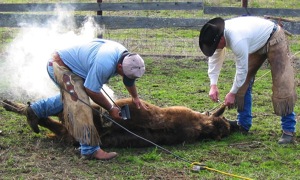
Have you ever seen cattle being branded? Me neither. But the branding iron leaves a mark. It marks the cattle as belonging to someone. There's a sense in which that's what John the Apostle is talking about in his letter, 1 John.

Branding and earmarkingEach of us may at times have doubts about our faith. You may ask, Am I really a believer? Has God really saved me? In 1 John, he wants to help provide assurance of the grace and hope available in Christ. So he describes what demonstrates the life of a real believer: the mark of faith, the mark of obedience, and the mark of love. These things will mark you for who you really are in Christ.

The central question that many of us may ask at certain points of doubt is: How do we know for certain that we are God's children, that we are His and He is ours? God tells us how:

This is how we are sure that we have come to know Him: by keeping His commands. The one who says, "I have come to know Him," yet doesn't keep His commands, is a liar, and the truth is not in him. (1 John 2.3-4, HCSB)

In other words, someone who says that he is a believer, but doesn't do what God says, is actually lying, and perhaps only deceiving himself. So John says, Do what God tells you, and it shows that you belong to Him.

That's the positive sense. But here's the negative sense:

You know that He was revealed so that He might take away sins, and there is no sin in Him. Everyone who remains in Him does not sin; everyone who sins has not seen Him or known Him. (1 John 3.5-6, HCSB)

This means that a person who truly knows God does not purposely and intentionally continue in sin. That's not the pattern of her life. Instead, a true follower of Jesus will, once sin is realized, confess and repent of that sin, and not continue in it. But continuing in sin—living in sin as a pattern of life—shows that we are not walking with Him and that we have never really known Him (v. 6).

Ultimately, it's a matter of staying close with God throughout each day ("remaining with Him"), and living life as He would live it, making the choices He would make. He shares it this way:

But whoever keeps His word, truly in him the love of God is perfected. This is how we know we are in Him: The one who says he remains in Him should walk just as He walked. (1 John 2.5-6, HCSB)

If you say you know Him, with His Spirit in you, then you will live each day (that is, "walking") the same way Jesus lived. This is the What would Jesus do? question.

Of course the real question that matters for all of eternity is, What has Jesus done? He lived perfectly and yet died in our place. He then rose from death. He's the supreme reality of both obedience and love. And a genuine believer in Jesus will want to live, love, and yes, even obey as Jesus did.

I realize that in my last post I said I would talk about the mark of obedience in one post, but after seeing how long it was running, I had to break it into two. The next post will look at how John specifically describes the difference between real followers of Jesus, and those who are not.

Take courage that you can know that you are His.

Tuesday, April 23, 2013

The Mark of Faith

Earlier I referenced some marks of a genuine believer that we can see in the biblical letter known as 1 John. In general, he explains the marks of faith, obedience, and love.

We talked about the mark of faith in three posts, so I simply wanted to link them together here in one place. We see the mark of genuine faith in what we can and cannot trust as described in 1 John:

In this way, we can't help but see the mark of true faith.

In the next two posts, I'll briefly address the mark of obedience and the mark of love, in one post each.

Monday, April 22, 2013

Teaching You Cannot Trust

John the Apostle, in his first letter, not only writes about who and what we can trust, he also tells us what we cannot trust.

What you believe about Jesus matters. John wrote to clarify that a true believer in Jesus will be shown by certain distinguishing marks: faith, obedience, love. We have previously seen that John says we can trust that Jesus had a real human body and that, at the same time, He was and is really God. Believing that Jesus is God, who took on a human body in order to rescue us, really matters.

But that means that you cannot trust any alternative teaching about Jesus.

You cannot trust teaching that denies the full divinity or full humanity of Jesus.

John tells us this in clear, stern terms:

Dear friends, do not believe every spirit, but test the spirits to determine if they are from God, because many false prophets have gone out into the world. This is how you know the Spirit of God: Every spirit who confesses that Jesus Christ has come in the flesh is from God. But every spirit who does not confess Jesus is not from God. This is the spirit of the antichrist; you have heard that he is coming, and he is already in the world now. (1 John 4.1-3, HCSB)

What in the world does that mean? Since they did not yet have the Scriptures that we now know as the New Testament, God provided prophets for the churches. They spoke from the Holy Spirit. They preached the gospel. Many prophesied and taught, and most of them taught the truth.

However, John was saying that some were speaking from another spirit, the spirit of the antichrist. Simply put, they were spreading lies. So John said the church should test these prophetic statements ("test the spirits"). The statements should be tested against other known truth. And one way to know that a prophetic statement was not from God was if it denied the humanity of Jesus, and by implication, the divinity of Jesus. This kind of teaching, John says, is not true, and you cannot trust it. (You can see this type of warning also from Paul in 1 Thessalonians 5.20-22.)

Notice that the "spirit of the antichrist" has been around since even the first century A.D. He has been deceiving people for a very long time. So John says to be on guard, because you cannot trust teaching that denies the full humanity (or full divinity) of Jesus.

If Jesus was not really a man, then He didn't die in your place, and you are hopeless. But He was, and He did. It matters.

If Jesus is not really God, then He didn't have the power or authority to save you and you are helpless. But He is, and He does. It matters.

Is your life marked by genuine faith?

Saturday, April 20, 2013

Jesus Was (and Is) Fully God

To say that Jesus had a real human body does not mean that He wasn't God. The opposite is true. When Jesus entered this world, He was fully man and fully God at the same time.

John the Apostle was clear that if you are a genuine believer, what you believe about Jesus matters. A true believer in Jesus will be shown by certain distinguishing marks: faith, obedience, love. Here we're talking about the mark of faith. True followers of Jesus will be shown by their faith. Believing that Jesus is God really matters.

You can trust that Jesus was (and is) also fully God.

Not only was it clear to John, who was there with Jesus, that He had a real human body, it was also clear that He was the divine Son of God. He says it this way in 1 John:

And we have seen and we testify that the Father has sent His Son as the world’s Savior. Whoever confesses that Jesus is the Son of God—God remains in him and he in God. (1 John 4.14-15, HCSB)

So believing that Jesus is God really matters. It matters that we believe that He was really a man, and that He was really God—at the same time.

It is not merely that God the Father saw a remarkable and holy man named Jesus from Nazareth, and then decided to adopt him. That is a heresy known as Adoptionism. Those who take this wrong view would essentially say that Jesus was such an amazing man on His own, that God saw Him from heaven, decided that Jesus would make a great Savior, adopted Him as His son, and then gave Him power and authority. This view completely contradicts key sections of Scripture.

Jesus was indeed born of God into this world, after the Holy Spirit overshadowed Mary (Luke 1.35; Matthew 1.18), but that does not mean He was created. Jesus, the eternal second person in the Trinity, was already with God the Father when they began creating (John 1.1-3).

The Apostle John simply affirms Him as the anointed God-man, the Messiah. And whoever believes in Him as the Messiah will be saved:

Everyone who believes that Jesus is the Messiah has been born of God, and everyone who loves the Father also loves the one born of Him. (1 John 5.1, HCSB)

Many centuries earlier, Isaiah had prophesied that His name would be Immanuel, translated God With Us. And that is exactly who He is.

You can trust that Jesus had a real human body, and that He was and is also fully God. When you do, it's a mark of faith.

Tuesday, April 9, 2013

Jesus Had a Real Human Body

The Apostle John wrote a biblical letter known as 1 John concerning what we can know about God, and about us. And he says we can know that we know God through Jesus Christ.

But false teaching had apparently cropped up where he was ministering. Some said then, and now, that Jesus only appeared to have a body, or that He merely seemed to die on a cross.

That may sound odd that some would question that Jesus had a real human body. But that seed of doubt has been used for centuries to cause people to stumble. So it's important to establish that Jesus did in fact have a real human body. And John clarifies that for his readers, and down through the centuries, for us.

John was trying to get across the idea that if you are a genuine believer, what you believe about Jesus matters. A true believer in Jesus will be marked by certain distinguishing marks: faith, obedience, love. The first that we'll talk about here is the mark of faith. True followers of Jesus will be shown by their faith.

And that faith must be rooted in the God who took on a human body to live perfectly, and then die and rise, in our place, instead of us. To do so, Jesus had to have an actual body, in which He actually died (and rose).

You can trust that Jesus had a real human body.

John says you can believe that. Why? Because he was there. John and his friends were with Jesus. They saw Him, they heard Him, they ate with Him, they touched Him, and they knew that He had a real human body. They were eyewitnesses in these early days of Jesus' ministry:

What was from the beginning, what we have heard, what we have seen with our eyes, what we have observed and have touched with our hands, concerning the Word of life—that life was revealed, and we have seen it and we testify and declare to you the eternal life that was with the Father and was revealed to us—what we have seen and heard we also declare to you, so that you may have fellowship along with us; and indeed our fellowship is with the Father and with His Son Jesus Christ. (1 John 1.1-3, HCSB)

God's word says that Jesus really took on a human body. If you can trust Scripture—and you can—then you can trust that He had a real body. John and his buddies were there, and that's among the most important early facts they reported to us about Jesus.

When Jesus came back from death and showed up in the locked, fearful room the disciples had created, He joined them in their room and wanted to reassure them. "Peace to you!" He said. And then "He showed them His hands and His side" (John 20.20, HCSB). He was real.

Then a little later when Thomas kept having doubts, which were normal, Jesus wanted to reassure him also, and said:

Put your finger here and observe My hands. Reach out your hand and put it into My side. Don't be an unbeliever, but a believer. (John 20.27, HCSB)

Thomas saw and believed. Jesus said those who hadn't seen and still believed are blessed, but He knew that these close friends would soon attest to the fact that His body was indeed real. He really died. He really rose from death.

This is the incarnation. He put on flesh. He put on bones. Specifically this is what we celebrate at Christmas each year. Born into this world, He put on a body.

If He didn't, or hadn't, we would be hopeless. But He did. And we have certainty, and we believe. And our lives are marked by faith.

Tuesday, February 5, 2013

The Marks of a Genuine Believer

Do you have a prominent, distinguishing birthmark? Or perhaps you have other markings like tattoos?

I've always thought it to be pretty interesting when a local news alert comes across the airwaves and a reporter says that police have offered a description of the suspect. They will tell the obvious details, such as height, weight, ethnicity, and the clothes they were wearing when they were last seen. But once in a while they will say something like, "…and the suspect has a large tattoo on his left arm with the words, Elvira Forever, prominently displayed." Bet they can't find that guy.

So do you have any marks?

The Apostle John wrote a letter in the New Testament that is all about what we can know about God, and about us. And he says we can know that we know God, through Jesus Christ.

These categories are nothing new with me, but over the next few posts, we'll be looking at three distinguishing marks of a true believer, according to John's letter. Genuine followers of Jesus will display:

  • The Mark of Faith
  • The Mark of Obedience
  • The Mark of Love

I hope this brief look into John's letter will provide the clarity and assurance that John intended.

I have written these things to you who believe in the name of the Son of God, so that you may know that you have eternal life. (1 John 5.13, HCSB)

Thursday, January 17, 2013

What Some People Don't Know

On the blog this week we looked at what the Apostle John says we know that we know. There are several spiritual truths that we can know with certainty. Most importantly, God's word says that we can know that we know God.

Interestingly, though, John also speaks about a few things that some people don't know. After each unknown, see John's words of concern from the letter of 1 John.

Those who hate their brothers or sisters in Christ don't know the direction they are going.

But the one who hates his brother is in the darkness, walks in the darkness, and doesn't know where he's going, because the darkness has blinded his eyes. (1 John 2.11, HCSB)

Everyone who hates his brother is a murderer, and you know that no murderer has eternal life residing in him. (1 John 3.15, HCSB)

Those who haven’t looked to God as their Father don't know or understand His children.

Look at how great a love the Father has given us that we should be called God's children. And we are! The reason the world does not know us is that it didn't know Him. (1 John 3.1, HCSB)

Those who continue in a life of sin don't know God.

Everyone who remains in Him does not sin; everyone who sins has not seen Him or known Him. (1 John 3.6, HCSB)

As you can see, this is a devastating list of unknown unknowns—things they don't know that they don't know. How can they know unless someone tells them?

I hope that you and I will take the time today to let others know all that is available in Christ.

Wednesday, January 16, 2013

Knowing What You Know

Yesterday we considered that although there are a vast number of things we don't know, when it comes to the most important things in life, we can have more certainty than we might initially think.

The Bible says that we can be sure that we know God through Jesus. We can have real certainty about who He is and who we are because of Him. We can know that we know God. For the believer, it is a known known.

And there are lots of other spiritual truths that John the Apostle says that we can know. In teaching through the letter of 1 John, it struck me how many things the Apostle says that we can know. By my count, he uses a form of one of the two main Greek words for know at least 40 times in 32 verses, throughout this five-chapter letter.

Below are six categories of items that John says we can know with certainty. The verses of Scripture that follow each statement are indicative of the ways that John speaks with conviction.

We know that the end of days could happen anytime.

Children, it is the last hour. And as you have heard, “Antichrist  is coming,” even now many antichrists have come. We know from this that it is the last hour. (1 John 2.18, HCSB)

We know that we have the truth about God.

I have not written to you because you don’t know the truth, but because you do know it, and because no lie comes from the truth. (1 John 2.21, HCSB)

We know what genuine love is, and how to show it.

This is how we have come to know love: He laid down His life for us. We should also lay down our lives for our brothers. (1 John 3.16, HCSB)

And we have come to know and to believe the love that God has for us. God is love, and the one who remains in love remains in God, and God remains in him. (1 John 4.16, HCSB)

We know that we have been given real life, escaping death.

We know that we have passed from death to life because we love our brothers. The one who does not love remains in death. (1 John 3.14, HCSB)

We know that God abides in us, and we in Him.

The one who keeps His commands remains in Him, and He in him. And the way we know that He remains in us is from the Spirit He has given us. (1 John 3.24, HCSB)

This is how we know that we remain in Him and He in us: He has given assurance to us from His Spirit. (1 John 4.13, HCSB)

We know that we have a saving relationship with God.

This is how we are sure that we have come to know Him: by keeping His commands. (1 John 2.3, HCSB)

I have written these things to you who believe in the name of the Son of God, so that you may know that you have eternal life. (1 John 5.13, HCSB)

And we know that the Son of God has come and has given us understanding so that we may know the true One. We are in the true One—that is, in His Son Jesus Christ. He is the true God and eternal life. (1 John 5.20, HCSB)

Remember, this is just a sampling of the 40 instances of what John's first letter says that we know. If we followers of Jesus lived our lives in the certainty and gracious boldness that is possible, we would make a much greater impact on our world.

I'm so thankful for the confidence that is available in Christ.

Tuesday, January 15, 2013

Knowing That You Know Him

How much do you really know?

You know more than you think you do. Or at least you can.

I can still remember the press conference in 2002 when Secretary of Defense Donald Rumsfeld made a statement that later became established in pop culture. A reporter had asked him a question by stating that there were "reports that there is no evidence" of something. Rumsfeld's response was classic Rumsfeld.

Reports that say that something hasn't happened are always interesting to me, because as we know, there are known knowns; there are things we know we know. We also know there are known unknowns; that is to say we know there are some things we do not know. But there are also unknown unknowns—the ones we don't know we don't know. And if one looks throughout the history of our country and other free countries, it is the latter category that tend to be the difficult ones.

—Donald Rumsfeld, February 12, 2002

There are certainly thousands of things you don't know. More like billions. But even when it comes to the most important concerns we have, we often have no certainty as to what the outcome will be. We have no idea if our loved ones will still be with us next year, or whether we will be healthy next month, or whether we will lose our jobs next week. When it comes to knowledge with certainty, it seems we don't know much.

So how about God, and spiritual things? That seems like an area where we might not know much. After all, that's the very definition of faith, isn't it? Believing without seeing?

We might be surprised to see just how much the Bible says we can know with certainty when it comes to our faith. The Apostle John, the same one who through amazing experiences had matured into a great man of God (see these posts), wrote in a letter about what we can know with certainty concerning God and ourselves, when we are in Christ. And he even says that we can know that we know God. Take a look at these remarkable words:

And by this we know that we have come to know him, if we keep his commandments. (1 John 2.3, ESV)

He actually uses the primary Greek root word for know twice in this sentence. I used to hear pastors ask, "Do you know that you know Him?" And I used to think it was funny that they would word it that way. But the fact is, John the Apostle essentially does just that.

We'll cover later what John is saying in 1 John 2.3, about doing what God says to do. But one thing is certain. He says you can know that you know God through Jesus Christ. And that's real certainty. Some translations even word it that way: "And by this we are certain…". 

God's word says that you can know that you know Him. That's profound. Do you know Him?

Next time, we'll look at more of what we know.

Thursday, December 27, 2012

What Changes Us?, Part 3

In studying the biblical letter, 1 John, I began wondering how the Apostle John turned from what appears to be a rather immature guy into a godly man who would write a powerful Gospel account, key letters, and a phenomenal Revelation, all while being a key leader in his early, local church. Through his ministry and Scriptures, John still speaks and still leads.

So what changed him? We looked at some key events here and here. Although many things happened to John that changed him, this final part includes the last two that I'll mention for now.

John observed the agony of Jesus.

John witnessed the suffering of Jesus. He was actually there. When we view movies that depict Christ's death, few even come close to showing what that kind of deep agony must have been. We sometimes forget that Jesus suffered even in the garden of Gethsemane. He suffered as He talked with his Father about what would soon happen. So much so that it was as if He were sweating blood. It was intense. And John was there.

Then they came to a place named Gethsemane, and He told His disciples, “Sit here while I pray.” He took Peter, James, and John with Him, and He began to be deeply distressed and horrified. Then He said to them, “My soul is swallowed up in sorrow—to the point of death. Remain here and stay awake.” (Mark 14.32-34, HCSB)

They were so exhausted that they eventually fell asleep. But they would not forget this dramatic event that changed them. Don't you think that would have changed you?

John took responsibility for the family of Jesus.

In a sweet gesture just before His death, Jesus wanted to ensure care for His widowed mother. So in one act of love, He took care of His mom and at the same time brought John into the family. Jesus was of course the firstborn among His brothers. Why He did not at some point assign the care of His mother to the next oldest brother is a mystery to me. Perhaps it was because John was maturing. He was changing. And Jesus trusted him. In this remarkable move, from the cross, He accomplished so much. Here is the story:

Standing by the cross of Jesus were His mother, His mother’s sister, Mary the wife of Clopas, and Mary Magdalene. When Jesus saw His mother and the disciple He loved standing there, He said to His mother, “Woman, here is your son.” Then He said to the disciple, “Here is your mother.” And from that hour the disciple took her into his home. (John 19.25-27, HCSB)

That final sentence says so much. John completed his assignment well. From that day forward, he knew that Jesus had entrusted the care of His mom to him, and he faithfully provided care. Don't you think that would have changed you?

In both of these instances, and all of the others we have seen, it is a sweet reminder for me to see all that happened to John the Apostle in changing him.

But then I remember that in various ways, these things have happened to you and me as well. I've come to a point of belief in Jesus through a personal encounter. I've seen, in some ways, the supernatural power of God at work. I've been appointed by Jesus in a special connection. I've come to appreciate the approval of Jesus by God the Father. I've come to understand the suffering of Jesus. And Jesus has brought me into His family. In a spiritual way, I've experienced these episodes just like John.

And so have you.

And when it's real, it changes us.

Tuesday, December 18, 2012

What Changes Us?, Part 2

Last time, we asked the question, essentially: What does it take for a man to change from a selfish, perhaps wimpy guy into an influential leader among Christians in the first century and beyond? John the Apostle was such a man. He became a great leader who wrote Scripture and helped lead the church into a new era.

So what changed him? We looked at two events previously. Here are two more life-changing episodes.

John was appointed in a special connection with Jesus.

The Gospel writers give lists of the Twelve Apostles, but Mark's list includes something interesting. It lists two examples of the nicknames that Jesus gave among the specially appointed team:

He appointed the Twelve:
To Simon, He gave the name Peter;
and to James the son of Zebedee,
and to his brother John,
He gave the name “Boanerges”
(that is, “Sons of Thunder”)…
(Mark 3.16-17, HCSB)

Perhaps we shouldn't read too much into this. But over the years, the folks who have chosen to give me a nickname are often those who have known me best, or worked with me the closest. I have many times done the same. A nickname is often a term of endearment, or a way to show a special connection. We know that Jesus began calling Simon by the name of Peter because of a special connection. And that's just what John the Apostle also had with Jesus. No one knows (now) exactly what Jesus meant by calling Zebedee's sons the Sons of Thunder—or however we should translate that! But my guess: it was a loving term of closeness.

I think, That sure would have changed me.

John's was certainly a special connection, but have you realized how special a connection you have with God? God knows your name, He knows your days, and even the number of hairs on your head. He may even have a nickname for you (okay, I made that part up, but it sounds just like His loving self to do something like that).

John witnessed the approval of Jesus by God the Father.

In one of the intriguing stories of the unfolding revelation of who Jesus really was and is, He allowed three of the Apostles to come to a very unique mountaintop prayer service. We call it the Transfiguration because Jesus' body and even clothes apparently began to glow! He was glorified right in front of them.

About eight days after these words, He took along Peter, John, and James and went up on the mountain to pray. As He was praying, the appearance of His face changed, and His clothes became dazzling white. (Luke 9.28-29, HCSB)

He spoke with Moses and Elijah, and then a cloud overshadowed them and the voice of God the Father said, "This is My Son, the Chosen One; listen to Him!" (v. 35). John and the others were able to be there when God the Father personally spoke on behalf of His Son to say that they should listen to Him. It's as though He was saying: The Law and the Prophets (represented by Moses and Elijah) are good, but this One—He is My Son! Be sure to pay attention to Him! Others had seen something similar at Jesus' baptism, but not this. This was a special revelation from God reserved for Peter, James and you guessed it—John.

I think, That sure would have changed me.

We may not have seen this transfiguration live, but what was once kept to themselves (v. 36) has now been told to the world through the Scriptures. And many of us have experienced God the Father's most significant approval…that of Jesus' sacrifice in our place.

More next time.

Monday, December 10, 2012

What Changes Us?, Part 1

As we began a new series at our church about What We Know from the letter called 1 John, I began thinking about the dramatic changes that clearly took place in the Apostle John's life. This is the fellow who at one point asked Jesus if he could sit in authority next to Jesus once His kingdom was in place. And apparently on another occasion, John allowed his mom to go to bat for him and ask Jesus the same basic question.

What kind of mature man stands idly by while expecting (or at least allowing) his mother to ask a selfish question about a promotion?

But, John did ultimately mature. He became the man of God that would write a powerful Gospel account, key letters, and a phenomenal Revelation that would be talked about for centuries to come (and still is).

So I wanted to remind myself of some of the significant events and experiences that John had during his earlier days. There were several instances in John the Apostle’s life that must have altered the rest of his life. What changed him (and what changes us)?

I'm going to point out six events that shaped John. Here are the first two.

John came to a point of belief in Jesus through a personal encounter.

I've always been intrigued by the way the Gospels tell the story of the first disciples' initial steps of faith in Christ. They must have known who Jesus was. But when He encountered them, in person, something began to change inside them. They believed in Him.

Going on from there, He saw two other brothers, James the son of Zebedee, and his brother John. They were in a boat with Zebedee their father, mending their nets, and He called them. Immediately they left the boat and their father and followed Him. (Matthew 4.21-22, HCSB)

Can you imagine what that must have been like? Jesus Himself called John to follow. And John did. Surely that personal encounter began to change John into the man he would later become. It must have been quite a feeling to have been directly and personally called by Jesus.

But then, aren't each of us directly and personally called by Jesus? Absolutely.

John saw firsthand the supernatural power of Jesus.

As the stories in the Gospels unfold, it is amazing to think about being there! But John didn't have to imagine it. He was there for some of the most significant miracles of Jesus. Here is one particular example.

As soon as they left the synagogue, they went into Simon and Andrew’s house with James and John. Simon’s mother-in-law was lying in bed with a fever, and they told Him [Jesus] about her at once. So He went to her, took her by the hand, and raised her up. The fever left her, and she began to serve them.
When evening came, after the sun had set, they began bringing to Him all those who were sick and those who were demon-possessed. The whole town was assembled at the door, and He healed many who were sick with various diseases and drove out many demons. But He would not permit the demons to speak, because they knew Him. (Mark 1.29-34, HCSB)

Then another time, John was present as Jesus raised from death a little girl. Very few got to see such a glorious sight. But look who was included:

After He came to the house, He let no one enter with Him except Peter, John, James, and the child’s father and mother. (Luke 8.51, HCSB)

It seems that the Apostle John was blessed to be able to witness in clear view many of the more well-known works of the Savior. He was there. And in some cases, he was given direct and special access. Certainly this up-close and privileged access to the supernatural work of Jesus would end up shaping John's life!

But then again, haven't there been times when you have seen God work in incredible ways? You may not have thought of them as miracles, but if it was God working in a specific way that you witnessed, didn't He grant special access? Absolutely.

To be continued.

Monday, December 3, 2012

From the Beginning

How do you start off your day? It seems many people contend that what you do first in the morning has a great impact on the rest of your day. Thus it follows that "breakfast is the most important meal of the day." Not sure who came up with that one; I would fail that test.

How do you begin a new year? Or any new phase? Certainly there is something powerful about starting well so that you can end well.

This all makes sense when we remember perhaps the three main inherent desires that each of us has. We all long for a sense of significance/value, we all need relationship/community, and we all desire an understanding our destiny (where we're going) and origin (where we came from; how we began). We Christians would contend that these desires are satisfied in Christ.

So it's not ironic that the Apostle John would focus on this third element: the origin, the beginning.

It's obvious to see what appears to be a parallel between how John starts the letter now known as 1 John, and how he starts the Gospel that bears his name. And both of those remind us of the first words in the Bible:

What was from the beginning,
what we have heard,
what we have seen with our eyes,
what we have observed
and have touched with our hands,
concerning the Word of life—
(1 John 1.1, HCSB, emphasis added) 

In the beginning was the Word,
and the Word was with God,
and the Word was God.
He was with God in the beginning.
(John 1.1-2, HCSB, emphasis added)

In the beginning God created the heavens and the earth. (Genesis 1.1, HCSB, emphasis added)

Regarding the parallels, some have said that in 1 John, he is talking about the eternality of Jesus, the "Word of life." They might cite 1 John 2.13-14: "the One who is from the beginning."

Others say that John is referencing the beginning of the proclamation of the gospel message, the "word about the Life." They might quote 1 John 2.7; 2.24, or 3.11: "For this is the message you have heard from the beginning."

I believe that John was smart enough to do both at the same time. Listen to how he continues chapter one, after the first verse:

…that life was revealed,
and we have seen it
and we testify and declare to you
the eternal life that was with the Father
and was revealed to us—
what we have seen and heard
we also declare to you,
so that you may have fellowship along with us;
and indeed our fellowship is with the Father
and with His Son Jesus Christ.
(1 John 1.2-3, HCSB)

The beautiful way in which John works in both the eternal nature of God and the consistent message of His grace is the starting point of a short letter in which he reminds us of all the things that we can and should know.

On Sunday mornings at Fellowship we are working our way through the letter of 1 John this Advent season. It may not be at the top of everyone's list of obvious Christmas texts of Scripture, but maybe it should be. John starts off with the genuineness of the incarnation of Jesus. That is Christmas—the miracle of the birth of the Messiah.

If you live in our area, we hope you can join us. If not, you can listen to our podcasts. And we'll be sharing some thoughts here along the way.