Showing posts with label Resources. Show all posts

Wednesday, January 4, 2012

Bible Reading Encouragement

On Sunday, my wife and I began a Bible reading strategy that I thought might be helpful to you as well. As a pastor, I find it relatively easy to stay on course when studying a paragraph of Scripture for a sermon or working through a Bible book as I teach or write, but consistency in reading outside of specific study is sometimes not easy. I really appreciate when the ease of technology puts together the best of the Internet’s abilities to do something that can actually help you grow in character.

Of course, with any Bible reading plan, if the only reason you are doing it is to say you’ve done it, or to check off boxes on a reading plan, it won’t change your life. But if you’re sincerely looking for a way to aid you in your reading, keep you on track, and even help to hold you accountable to a real-life person, this can be a super assistant, and may even be beneficial in your Godward progress.

YouVersion.comIt’s a free tool from YouVersion.com, which offers a series of Bible reading plans. You can simply read any paper and ink Bible and check off the day’s scheduled reading, or you can have the Bible delivered to you in a variety of ways. You can have YouVersion send you a daily email with the first part of your reading embedded, so that you’re encouraged to start there and then click through to the site where you can complete your reading and check off the day’s plan. Or you can simply go to your main login page, where the plan automatically (if you stay signed in) pulls up where you’re supposed to start for the day. If you’re on your smartphone a lot, YouVersion has free apps available (iPhone, Android, others) that will let you read on your mobile device, and then whatever your read on mobile will sync with the full Web version so that you don’t have to keep checking in both places.

The service helps keep you on track, gives the ability to share Scripture on Twitter and Facebook, and it uses real friends, if you wish, to help hold you accountable. If you opt in to accountability, it will send reading progress reports via email to whoever you assign as an accountability partner. So my wife and I will be helping each other in this way. We chose the same reading plan, in part so that we can talk about what we’ve read together.

I look forward to coming back to the blog and posting how this has been a blessing in our walk with God—and even in our marriage.

Saturday, December 31, 2011

Getting the Message Out

As I began pastoring our church in 2011, part of our vision for our church was to help us move forward with newer ways to reach people with the same old, wonderful message of the Bible: that God saves us in Jesus Christ.

Fellowship WebsiteIn September we were able to roll out a newly redesigned website for Fellowship at www.fellowshipfamily.com. I pray that this will be great way for folks in our city to get initial information about who our church is, and why we do what we do. I hope you can stop by the website also, and maybe even our church.

Another small facet of this year’s vision for progress was to bring our sermons online. In the process of working toward this goal, I found that our church had in prior years podcast the sermons, but that it had stopped somewhere along the way. I am happy to announce that it has begun again.

Fellowship ResourcesWe have once again begun audio podcasting of our Sunday messages. You can listen to them on your computer, tablet, or mobile device, or you can download them to listen later. You may also subscribe to receive all updated sermons as they become available, using iTunes or generic podcasting subscription services.

All of the messages from the current series, Luke's Gospel: Good News for the Nations, are now available. Just go to the Media tab of our website.

We pray these resources will point you to faith in Christ for the first time, or strengthen your faith in Him!

Friday, December 30, 2011

The Church, The Community of Truth

We have finally completed a series of thoughts on 1 Timothy. This trust of guarding the gospel, as the community of truth, is a great and awesome privilege for your church and mine. I pray these notes can be encouraging and challenging.

  1. A Loving Command (Introduction)
  2. Protecting the Integrity of the Gospel (1 Tim 1.3-4)
  3. Promoting the Goal of the Gospel (1 Tim 1.5-7)
  4. Proclaiming the Grace of the Gospel (1 Tim 1.8-11)
  5. Preserving the Progress of the Gospel (1 Tim 1.18-20)
  6. Intense Desire for Ministry (1 Tim 1.12-17)
  7. Gospel-Advancing Prayer (1 Tim 2.1-8)
  8. Purposeful, Ordered Design (1 Tim 2.8-15)
  9. Proven Character for Leadership (1 Tim 3.1-7)
  10. Respectable Volunteer Leaders (1 Tim 3.8-13)
  11. The Pillar and Pattern of the Truth (1 Tim 3.14-16)
  12. Falling Away from Faith (1 Tim 4.1-5)
  13. Good Servants of Christ Jesus (1 Tim 4.6-16)
  14. Church Life as Family (1 Tim 5.1-16)
  15. Maintaining Trustworthy Elders (1 Tim 5.17-25)
  16. When God Doesn’t Change My Circumstances (1 Tim 6.1-2)
  17. Godliness with Contentment (1 Tim 6.3-10, 17-19)
  18. Guarding the Trust (1 Tim 6.11-16, 20-21)

Tuesday, May 25, 2010

The Community of Truth – Series Archive

A Series on 1 Timothy

Below you can find links to a series we will be developing here in the coming days on the biblical book of 1 Timothy. This post will serve as the series permalink, with parts updated as they are posted. We pray this will become a helpful resource in your Godward progress.

  1. A Loving Command (Introduction)
  2. Protecting the Integrity of the Gospel (1 Tim 1.3-4)
  3. Promoting the Goal of the Gospel (1 Tim 1.5-7)
  4. Proclaiming the Grace of the Gospel (1 Tim 1.8-11)
  5. Preserving the Progress of the Gospel (1 Tim 1.18-20)
  6. Intense Desire for Ministry (1 Tim 1.12-17)
  7. Gospel-Advancing Prayer (1 Tim 2.1-8)
  8. Purposeful, Ordered Design (1 Tim 2.8-15)
  9. Proven Character for Leadership (1 Tim 3.1-7)
  10. Respectable Volunteer Leaders (1 Tim 3.8-13)
  11. The Pillar and Pattern of the Truth (1 Tim 3.14-16)
  12. Falling Away from Faith (1 Tim 4.1-5)
  13. Good Servants of Christ Jesus (1 Tim 4.6-16)
  14. Church Life as Family (1 Tim 5.1-16)
  15. Maintaining Trustworthy Elders (1 Tim 5.17-25)
  16. When God Doesn’t Change My Circumstances (1 Tim 6.1-2)
  17. Godliness with Contentment (1 Tim 6.3-10, 17-19)
  18. Guarding the Trust (1 Tim 6.11-16, 20-21)

Monday, March 8, 2010

A Perfect Injustice

Here is another well-produced video, this time with super photography, on the ministry to street children in Kampala, Uganda that I mentioned last time.  Again, the photography by Phillip Glickman is amazing.  Watch.

Support the ministry of Global Hope Resources.

Tuesday, March 2, 2010

Vote for Global Hope

Embedded below is a short video about a ministry of Global Hope Resources, and the work of Abby Tracy in Kampala, Uganda.  The piece is a submission by Sophia Ruvolo to YouTube’s Project: Report contest.

Just last week, Abby came to our church while in the States to speak at our missions festival, and she also spoke in my LIFE class.  Her heart for street children in Kampala is contagious.  God is continuing to bless this work, and one small way that you can help this ministry gain exposure is by watching the video, and then voting for it on Project: Report.

If your browser works as it should, you can simply mouse over the video while it plays, and at the bottom of the clip (while playing) it will offer the opportunity to vote.  If you are not able to vote this way, go to the Project: Report channel on YouTube, click on Vote, search among those videos for ‘Global Hope,’ and you will find the same video.  There you should certainly be able to vote (to the right).

Enjoy the video.  Praise God.  Pray for Abby and the kids.  And vote.

Friday, December 4, 2009

Year in Review 2009: SimChurch Preview

Tonight’s post will be extra short, as my sickness recovery took a retreat, and I’m not feeling well at all this evening.

My light and temporary illness causes me to think even more about the Chandler family.  I’m still praying for Matt Chandler, lead pastor at The Village Church near Dallas, Texas, who underwent surgery today to remove a significant portion of the right frontal lobe of his brain after a seizure last week prompted several tests.  His faith and resolve, reflected in a statement posted this morning before surgery, is powerful.  I encourage you to read it.

As for the year in review part, tonight’s post looks forward into December for a book I plan to read.  My attention was caught recently by a book title released in October, and was further heightened when I looked at the author’s name and I realized I know him!

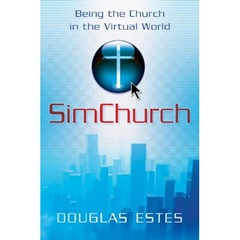
SimChurch cover Although I haven’t read it yet, this month I plan to take up SimChurch: Being the Church in the Virtual World, published by Zondervan.  Douglas Estes is an old friend from church and seminary, who now pastors and teaches in California.  We actually ran into Douglas and his family recently at park here (back towards the Eastern shores), when they were in town to visit their extended family.  I’ll write more about the book and Estes later, but you know this volume has to have some cred when his doctoral thesis from the University of Nottingham, UK, was titled, The Temporal Mechanics of the Fourth Gospel: A Theory of Hermeneutical Relativity in the Gospel of John (Brill, 2008).

Again, more on this later.  For now, after some rest I have to go brush up on my temporal mechanics.

[This is the fourth in a series, based on a blog challenge.]

Sunday, August 2, 2009

Dimensions of the Atonement of Christ

As a follow up to the previous post, and in an effort to again publish some notes from my class, here is a concise list of what happens in Christ’s atonement for us.  Although not exhaustive, these items represent the basics of Christian thought on what takes place in the penal substitution view (see previous post) of the atonement of Christ.

1. The need for a sacrifice

God cannot simply overlook man’s sin, nor can He just forgive man without requiring that payment be made or punishment be given for sin.

2. The payment of a penalty

This is done in order to regain favor with, or even appease, God.  His anger against sin, or wrath, can be satisfied only by the execution of His justice.

3. The substitution of Jesus (for us)

The atonement is a sacrifice offered in place of the sinner.  Thus the sacrifice bears the sinner’s guilt.

4. The application of righteousness

God has taken away the guilt of believers, but He has also imputed to them the righteousness of Christ.

5. The reconciliation of a relationship

Although apart from Christ we had been God’s enemies because of sin, now with Christ we have been reconciled and have new life.

Tuesday, July 28, 2009

Understanding the Atonement

What follows are some of the views or theories of the atonement that developed over the centuries.  The list is not exhaustive.  Only the penal substitution view (#6 below) carefully follows the teaching of Scripture.  The other theories/views either are or lead to heresy, and have been instrumental in the starting of sects or cults.

This information can be found in many good systematic theologies.  I am publishing the summary here as an easy reference for the folks in my Bible study class, but hopefully others can benefit as well.  In many ways, tracing the development of these views of the atonement can help one appreciate the deep value of what Christ accomplished for those who trust in Him.

1. Ransom to Satan Theory

  • Definition: Christ’s death was a ransom paid to Satan to purchase captive man from Satan’s control
  • Claimed as support: Matthew 20.28; Mark 10.45; 1 Corinthians 6.20
  • Condition of man prior to Christ’s work: In bondage to Satan
  • View results: Christ’s death brought God’s victory over Satan, thus it purchased man’s redemption and freedom from bondage to Satan

2. Dramatic Theory

  • Definition: Christ is victorious in a divine and cosmic conflict of good vs. evil and wins man’s release from bondage
  • Claimed as support: Matthew 20.28; Mark 10.45; 1 Corinthians 15.51-57
  • Condition of man prior to Christ’s work: In bondage to evil
  • View results: Christ’s death brought God’s victory over Satan and evil, thus it purchased man’s redemption and reconciliation from its bondage to evil

3. Example Theory

  • Definition: Christ’s death provided an example of faith and obedience to inspire man to be faithful and obedient—to live a good life
  • Claimed as support: 1 Peter 2.21; 1 John 2.6
  • Condition of man prior to Christ’s work: Spiritually alive and capable of good effort (according to Pelagius)
  • View results: Christ’s life and death was the perfect example of faith and obedience, thus it brought inspiration to live well

4. Moral Influence Theory

  • Definition: Christ’s death demonstrated God’s love, which causes man’s heart to see God’s goodness and to repent
  • Claimed as support: Romans 5.8; 2 Corinthians 5.17-19
  • Condition of man prior to Christ’s work: He has a sickness in his soul and needs to be, as it were, revived
  • View results: Christ’s death demonstrated God’s love toward man, thus man is moved to accept God’s forgiveness

5. Governmental Theory

  • Definition: Christ’s death demonstrates God’s high regard for His law and His hatred toward sin, and Christ’s death would offer an acceptable rationale to forgive sin
  • Claimed as support: Psalm 2, Psalm 5; Isaiah 42.21
  • Condition of man prior to Christ’s work: A violator of God’s moral law
  • View results: Christ’s death was a substitute for the penalty of sin, thus it is legal for God to forgive those who accept Christ as their substitute

6. Penal Substitution Theory

  • Definition: Christ’s death was a substitutionary sacrifice that satisfied the demands of God’s justice and wrath upon sin, paying the penalty of man’s sin while man receives the blessing of Christ’s righteousness
  • Claimed as support: John 11.50-52; Romans 5.8-9; Titus 2.14; 1 Peter 3.18
  • Condition of man prior to Christ’s work: Totally depraved and incapable of doing good or earning God’s favor
  • View results: Christ through His death bore the penalty of sin in man’s place, thus, as a gift, man is granted repentance and faith, and can accept Christ’s substitution as payment for man’s sin, which brings forgiveness, imputes righteousness, and reconciles man to God

Wednesday, April 8, 2009

David Horner: Principles and Lessons Learned

Last night I attended the SendRDU Church Planting Forum at The Summit Church.  As mentioned here previously, my pastor David Horner spoke on the topic of "The Church that Will Outlive You: Planting a Church that Will Last."  He started Providence in 1978 and has led the church for over 30 years, so he has the requisite experience to talk to planters about a church's longevity and consistency.  More info, and potentially the forthcoming ability to listen to or download the audio of the event, is available at the SendRDU website.  You can find out more about David at the Providence site.

David Horner

David Horner

Amy and Matt Morgan

Amy and Matt Morgan

Mike Hall and Blake Hickman 

Mike Hall and Blake Hickman

Not pictured: Nick Roark and George Tissiere, who apparently chose not to sit at Matt's front-and-center table. ☺

Monday, April 6, 2009

SendRDU Forum with David Horner

Last minute, but wanted to broadcast this opportunity for tomorrow evening, Tuesday, April 7, for everyone in the Triangle area.  David Horner, my pastor (and boss), will be speaking about churches that last at a church planting forum at The Summit Church.  From the SendRDU website:

Church Planting Forum - April 7th

David Horner
The Church that Will Outlive You: Planting a Church that Will Last

Tuesday, April 7th, 7-8:30 pm
The Summit Church, Brier Creek Campus (map & directions)

SendRDU
SendRDU is a network of churches in RDU partnering together to equip leaders to plant gospel-centered churches in RDU, North Carolina, North America, and cities around the world.

Our monthly Church Planting Forums are designed to equip leaders to apply church planting principles to ministry.

Upcoming Forums: May 5th - J.D. Greear will speak at Providence

About the Speaker
David Horner is the founding pastor of Providence Baptist Church, and he has served as the senior pastor ever since. A native of Graham, NC, he received a Bachelor of Arts from Wake Forest University and holds a Master of Divinity from Gordon-Conwell Theological Seminary. He has authored three books, including Firmly Rooted, Faithfully Growing,  and Dad’s Words of Wisdom. Most recently he wrote, A Practical Guide for Life and Ministry, which offers help for people in ministry who are trying to maintain a biblical balance in their lives.

Friday, April 3, 2009

Exponential 09

Wanted to mention this great opportunity: the upcoming Exponential Conference in Orlando, FL.  The conference is also, or perhaps formerly, known as the National New Church Conference.  This year, instead of focusing primarily on the science and practice of church planting, the organizers hope to emphasize the art and movement aspect of starting new churches.  Click the banner below for more info.

2009 National New Church Conference

Sunday, August 31, 2008

The Implications of the Gospel

Apparently there are quite a few folks, even in the evangelical world, who cannot agree on a basic understanding of the gospel of Jesus Christ.  So let's take a look at the debate concerning the gospel.

In January of this year, an article by Tim Keel, pastor of Jacob's Well in Kansas City, Missouri, was published in Leadership Journal (a publication of Christianity Today) that was titled, "An Efficient Gospel?".  He argues that modernism has "reduced" the gospel into a set of propositions, and that our understanding of the gospel is too small.  Keel believes that many evangelicals see Jesus only as Redeemer and tend to downplay or "miss" that He is Creator as well.  He contends for a more Kingdom-minded approach to the gospel.  Although apparently well-intentioned, it seems that Keel is misguided in trying to expand the meaning of the gospel.

The Spring 2008 issue of Leadership Journal brought an article by Tim Keller, pastor of Redeemer Presbyterian Church in Manhattan, New York City, titled "The Gospel in All Its Forms."  Keller argues that there is only one gospel, but that it can be communicated in various forms.  While I generally agree with Keller's premise and conclusions (and completely agree that there is only one gospel), I would have encouraged a different word than "forms."  To me, as if my opinion meant anything, those are not different forms of the gospel he refers to in the article.  This may be a mere semantic difference, but to me it is an important one.  To say there are different forms of the gospel in Scripture could sound confusing to a nonbeliever (and perhaps to some believers).  The idea of four primary gospel components, such as God-sin-Christ-response, or God-man-Christ-faith, or creation-fall-redemption-restoration, comprise the same form of the gospel.  They are simply different angles from which to view the one form of the one gospel message.  That said, I commend his article.

In April, Mark Dever, pastor of Capitol Hill Baptist Church in Washington, delivered a message at the Together for the Gospel conference in Louisville, Kentucky, titled, "Improving the Gospel."  Dever, in part, responds to Keel, and is correct in confronting those who want to expand on what they consider a "reduction" of the gospel.  While few conservative evangelicals will disagree with the tenets of his message, many would probably find it difficult to take things as far as Dever does (like, for example, his illustration of his own unwillingness to offer advice on how a biblical worldview could inform a governmental official's question, based on the belief that it's not his job as a preacher of the gospel).  Mark is a friend (okay maybe only on Facebook, but I have spent a little time with him), and I think I know his heart.  But let's just say that Mark likes to stir the pot every now and then—and he would agree (he says of this conference message that he was "deliberately provocative and deliberately slightly overstated").  Maybe we need some issue-raising pot stirring every now and then.

Here you can see Ed Stetzer interviewing Mark Dever, and at one point they specifically discuss Dever's message referenced above.  Part 1 is certainly interesting, but Part 2 which is embedded here speaks to the discussion at hand, from about 3 minutes, 40 seconds through about 8:20.

Others have stepped into the fray as well, and it is a worthy discussion.  The truth of the gospel is at stake and it is worth fighting for.  But it begins with a question that Tim Keel said a camp director asked years ago: "If someone were to ask you what the gospel is, what would you say?"

In answering that question, many today are including the implications of the gospel—like caring for the poor and hungry—in their answer.  While it is absolutely true that we should right the wrongs in society and think more Kingdom minded, we must remember that personal accountability before God for one's sins ultimately comes down to that person's repentance and faith in response to Christ's death and resurrection.  Caring about societal problems is vastly important, but that care should flow from a person's (and collectively the community of faith's) response to the gospel.  It is the result of living in the gospel, having believed it.

So brothers and sisters, go live the gospel!

Sunday, June 1, 2008

The Shack?

At the outset, I must admit that I have not yet read the book, The Shack, by William P. Young.  But recently while in a large gathering I was attending, the speaker recommended the book with unspecified caveats.  I was curious and perhaps even intrigued at the speaker's enthusiasm for the book, and thought I should promptly check it out.  With other books on my to-be-read list, I thought maybe I would try to find a good review or two, to see what made the book so special.  One such review actually found me.

I was forwarded (hat tip: Blake Derrick) a review by Tim Challies.  His review is well worth your time.  On his blog he has posted a brief explainer, and then his review in PDF format.  With care and respect, Challies writes a cogent piece wherein he specifies several points at which The Shack, even in its genre of fiction, communicates an understanding of God that seems foreign to the Bible.  Perhaps Young never intended to write a theological treatise.  But whatever his intent, when people are seeking to understand God through The Shack instead of The Bible, we have a problem.

If you have read the book or plan to read it, I encourage you to take the time to read Challies' review.  Even if you do not agree with everything in Challies' wording or argumentation, his central warning is well placed.  He calls the book "dangerous," due to the extent of error.  Quoting from the book in several instances, he articulates problems in what Young communicates about God in the theological concepts of revelation, salvation, and the Trinity.

Both Al Mohler and Mark Driscoll agree in calling parts of the book heresy, so you know that major lines of orthodoxy appear to have been crossed.

When I disagree over a book's premise or content, I usually let it go.  However, of grave concern to me is the widespread appeal, not of the fictional story, but of the perceived theology of this book (just check out the many "this changed my life" and "this is the best explanation of the Holy Trinity" reviews on Amazon.com).  As of this writing, the book is #8 on Amazon's sales rank list.  It has become a phenomenon of sorts, and thus I sensed the need to flag these concerns here.

Friday, May 16, 2008

reThink Conference 08 Notes

UPDATE: Alex Chediak has posted all notes.  Here is Session 1 (Leon Tucker), Session 2 (David Horner), Session 3 (Dave Owen), Session 4 (Steve Wright), and Session 5 (Randy Stinson).

Original post follows.

-----

As mentioned in an earlier post, Providence Student Ministries Pastor Steve Wright has written a book titled, reThink (check here for details).  The convictions that inspired that book also initiated reThink Conference 08, which was hosted today at Providence.

Here is the purpose for the meeting from the conference's registration website:

The reThink Conference is for youth pastors, pastors, education pastors, parents and youth leaders who desire a greater biblical understanding of how the two primary institutions that God has established in the Bible—the family and the church—work together in the context of youth ministry.

Today's conference was sponsored by Providence, Two Institutions, and InQuest Ministries.

If you missed the conference, my new friend Alex Chediak has offered you a valuable resource: he live-blogged the conference, which means extensive notes will soon be available for you.  He even flew in from California to join us for the event.  At this writing, Alex's notes from the first session by Leon Tucker are posted, and the remaining sessions will follow as soon as he able to edit them.

You can find Alex's reThink Conference 08 notes in his blog.

Friday, February 1, 2008

New Providence Team Resources

We have some very gifted leaders at our church, and I thought it would be good to introduce you to three newly-released or soon-to-be-released resources that I believe could be very beneficial to your Godward progress.  For the two books mentioned below, I hope to provide in the future a sort of review, or at least overview, in order to give an idea of what to expect.  But for now, here is a brief snapshot.

Horner book cover Our senior pastor, David Horner, has written a new book titled A Practical Guide for Life and Ministry, which will be available in late February or early March from Baker Books.  The subtitle is Overcoming 7 Challenges Pastors Face.  Although this book is geared towards pastors as a primary audience, I would say that the principles are transferable to anyone who wants to live a balanced life regardless of role.  David has a passion to equip others in life and ministry.  His first major written work, Firmly Rooted, Faithfully Growing, contains a biblical framework for principle-based ministry, where he details a healthy model for church life, philosophy and structure.  He has also produced a book for fathers, Dad's Words of Wisdom.  Both of these books are available at our resource center.  Again, this new Life and Ministry balance book will be available by early March at most bookstores, and can be preordered now from Barnes & Noble, Amazon, CBD, WTS Bookstore, ...you get the idea.

Wright book cover Our student ministries pastor, Steve Wright, also recently released a new book, reThink.  This book takes a thoughtful and respectfully critical look at where many youth ministries are today, and asks the reader the question: Are these types of student ministries accomplishing what we think and hope they are?  He has such a heart to see parents actively involved in their children's discipleship.  Steve's book is available several places as well, but we recommend you get it from the publisher, InQuest Ministries.

DR_Websmall Daniel Renstrom is our college ministry director.  Although you can hear Daniel's work on the college ministry worship team's previously released worship album called Vaunted Pleasures, and although he has sung with the Shelly Moore Band, this is his first solo venture (solo doesn't mean that he's not backed by a great band).  This six-track EP titled adore and tremble is excellent, and will bless your personal worship time.  It is available for purchase at Providence, and will soon be available online at his website and on iTunes.

I pray, along with these brothers of mine, that these resources will equip and encourage you.